Showing posts with label India. Show all posts

Friday, February 6, 2009

Parul Gupta- Sustainable Development


Ox·y·mo·ron is a noun, referring to a rhetorical figure in which incongruous or contradictory terms are combined. For example: deafening silence, mournful optimist, blank copy.

Some “experts” would want to add the phrase sustainable development to the above list of examples. Such critics of the concept of sustainable development also suggest that it should instead be termed as “sustainable de-growth”, since they believe that environment and development (or growth) are antithetical to each other; that is, environment degradation is the price that needs to be paid if development is to be achieved. Deteriorating environment is often linked with increasing economic activity, requiring deforestation, energy consumption etc. “Development” is usually held responsible for environmental damage, while environmentalists are accused of being “anti-development”! Even a popular economic concept, such as the “Environmental Kuznets’ Curve” suggests that environment degradation increases, with an initial rise in per-capita income, and later decreases with further development.

However, to view environment and development as antagonistic terms is to have a very narrow viewpoint. Once the perspective is broadened, development and environment can be seen as complementing each other.

Sustainable development is a pattern of resource use that aims to meet human needs while preserving the environment so that these needs can be met not only in the present, but in the indefinite future. In other words, development that meets the needs of current generation without compromising the needs of future generations is termed as sustainable development (as defined by the Brundtland Commission). Thus, when development is viewed in terms of “quality of life” and not mere “numbers”, the complementarity between environment and development comes to the fore.
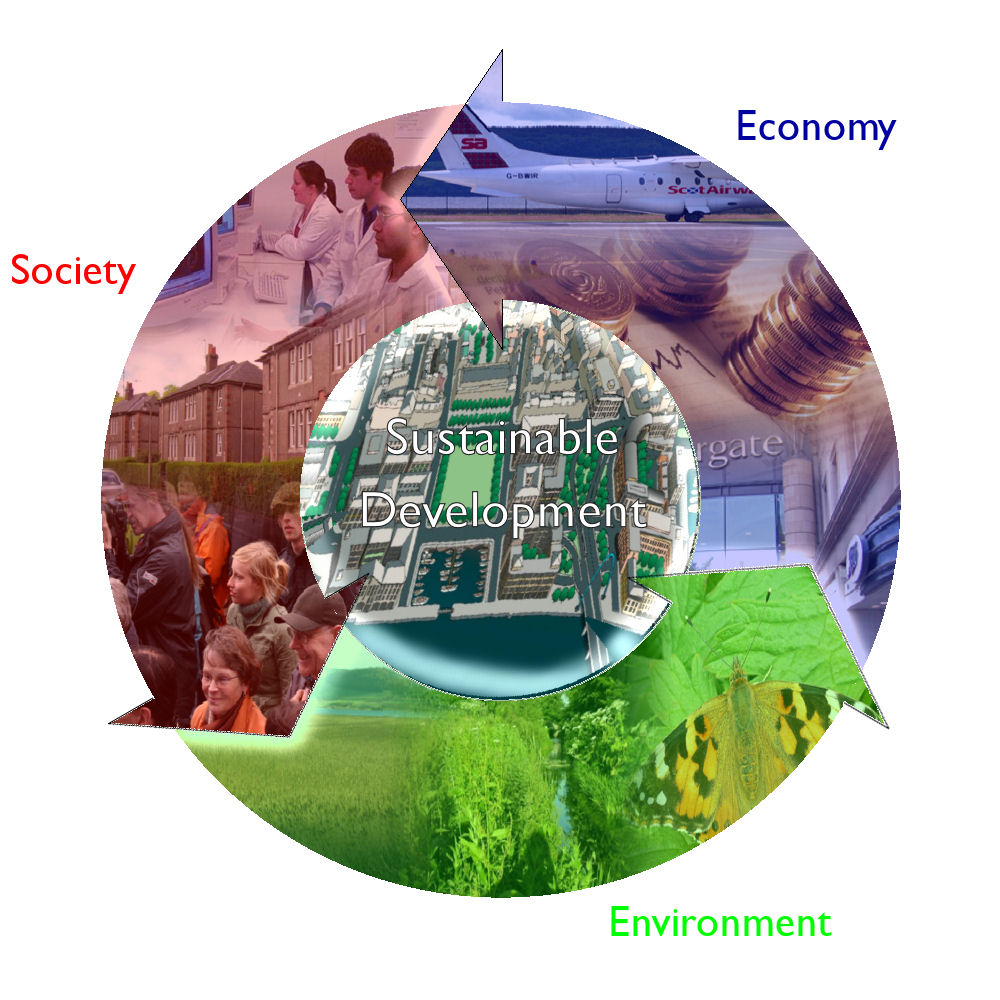


To refute the notion that environment degradation is a necessary condition for growth and development, I suggest two propositions, which assert that environment and development can, and should exist simultaneously.

Firstly, development can help conserve environment. Thus, both growth and environment conservation can be achieved together.

Constructive intervention can help enhance the quality of environment; and development facilitates constructive intervention. Thus, development can not be provided as an excuse to hamper environment. In fact, progress in the field of science and technology has given us the tools to protect the environment. Efficient electrical appliances, fuel-efficient vehicles, better methods of recycling and waste disposal, the concept of green architecture and many other such techniques are all a result of scientific advancements, which have been made possible due to investment in the field of technology. Undoubtedly, technology has made us lazy and seemingly insensitive towards nature and environment, but no one can deny that technology alone has opened up possibilities of adopting a greener lifestyle. It is, therefore, our choice: whether we wish to use technology to conserve or destroy the environment.

Secondly, environment degradation can ultimately lead to reversal of development. Thus, harming the environment to achieve “higher growth” is surely a risky prospect.

Without a clean and green environment, development has no meaning. The starkest example of this proposition would be a person who earns a 7-digit salary, but suffers from respiratory diseases due to air pollution and hence has to spend a huge portion of her/his income on medical expenses!

In addition, pollution and depletion of natural resources adversely affects livelihoods of all those who are directly dependent on the environment. Fishermen, cultivators, dairy farmers and many others are deeply affected by water pollution, soil contamination, acid rains, depletion of bio-diversity and other forms of pollution. Thus degradation of environment clearly affects employment and growth.

Moreover, noted economist and Nobel Laureate Amartya Sen asserts that environmental plunder affects distributive justice, which is an important branch of development. Pollution is caused by the affluent classes (effluents from industries, vehicular pollution, wastage of resources etc.) but its ultimate effects are borne by the disadvantaged (scarce resources, contaminated water, poor air quality etc.). Sen strongly condemns this “disguised manslaughter”. This clearly highlights the fact that severe environment damage can retard rather than promote development, through its strong distribution effects.

These linkages unambiguously underline the complementarity between environment and development. Without doubt, one can’t exist without the other.

Surely, sustainable development is not an “out of reach” phenomenon. To achieve it, we just need some simple measures, common sense, practicality and sensitivity towards the environment. We need an integration of developmental and environmental concerns. Every society, at each level can contribute towards conserving the environment. The government can make intelligent policies and ensure strict implementation of the laws. In addition, a system of incentives and disincentives could be devised, aimed at protecting the environment. For instance, efficient appliances (CFLs etc) could be subsidized, while pollution causing vehicles (fuel-guzzling SUVs) could be taxed heavily. Educational institutions can also contribute by spreading awareness and internalizing the issue in young minds, with the help of NGOs. Enterprises can fulfil their corporate social responsibility by minimizing wastage in their offices, using efficient equipment and adopting environment-friendly production processes. At the individual level, simple steps like minimizing wastage of paper, water and electricity at homes, avoiding littering in public places and above all, being aware and conscious of environment issues can go a long way in repaying our debt towards the environment.

To conclude, I would yet again assert that sustainable development is, by no means, an oxymoron. Instead, it is a phrase that needs to be incorporated in our lives at each level. It is an ideology that should be the foundation of government policies, if we genuinely wish to leave behind a clean and green Earth for our future generations.

______________________

The Author is a III yr B.A. Economics Honours student and part of the Webteam of DevelopmentChannel.org

Kirthi Rao- Environmental Change


While the indifferent have lived pretty happily till now, quite ignorant of the damage their apathy has lead to, it will no longer be possible. Part of the reason why common people ( let me define 'common' as people having access to basic education and a basic standard of living) have been able to ignore the environmental implications of their actions has been that they have been insulated from it. Lining one's home with wood when it wasn't really required, not bothering to relocate and rehabilitate cut trees, wasting water, avoiding pollution checks for one's vehicle, buying that shahtoosh shawl when the conservationists were crying themselves hoarse about the endangered species- none of these actions meant that your house would be hit by a tsunami, or your neighbourhood will become extra polluted or suddenly waterless or inhabitable. But, now very soon things will have to change.

I'm saying this because the nature has started retaliating. Of course we can develop newer technology to defend ourselves. But my point is that increasingly, it'll become a fighting race. I wonder if anyone has noticed the kind of smog we've experienced this winter. I agree that one always feels that the current situation is the worst ever, but this time many weather monitoring bodies like CSE (Centre for Science & Environment) agree with me and point out that the RSPM (respirable suspended particulate matter) levels seem to be much higher than they were three years back in the windless winter days. The cause of this is the increased vehicular pollution; the burning of dry leaves and waste in the winters, the continued clearing of trees in the Capital for the Commonwealth games. For instance visit the area near Gargi College, where a wooded area has been cleared ruthlessly, so much so that the road adjacent to it is carpeted with dust now. The list goes on.


What this has caused is amply clear. Respiratory problems have been on a rise, and the Delhiite (the story holds for other cities too) who has already suffered at the hands of ever-choked killer roads, now has the added disability of not being able to see clearly in the thick smog! I speak from personal experience. Travelling Noida to Delhi in the morning and back at night, to and from work is a necessity for my family and the horrors we (and our co-commuters) faced in the first few days of January must be shared. The visibility was as low as 25 metres sometimes and due to the added truck-traffic in these hours, the commute was indeed a trial by fog. Just imagine you are in your car on a usually busy road and all you see through your windscreen is white smoky layers of smog. We saw how unnervingly easy it was for a disastrous accident to happen and indeed many fatal collisions occurred. And this is just one instance of our lives being directly affected by the way we treat our environment.

Consider the Mumbai floods of 2005. It was not only the antiquated and poorly managed drainage system which was to blame, the steady degradation, reclamation and habitation of important mangrove areas and land-sea bridge areas in the Mahim creek was a major reason. What's pitiful is that very few people even spoke about it while they were losing their breath over criticising the Brihanmumbai Municipal Corporation for the poor drainage infrastructure. This is alarming because this loss of the Mithi river and Mahim creek mangrove area had already reached a rate of 40% from 1995 to 2005; apathy will ensure that an even higher percent of the essential eco-drainage systems will be lost.

What is most important is that we speak to all we know about these issues, their causes and the need to put a stop to our ignorant plundering. And more importantly, put a stop to our plundering, careless, polluting ways!

________________

The Author is an executive member of the Website Team of DevelopmentChannel.org

Monday, February 2, 2009

Rishabh Gulati- Treating The Malaise- Tackling Corruption in India


Corruption, a pervasive putrescence used to describe a malaise in the human body, has a different but equally troubling impact on the body politic. An embedded system, of complex and necessary gratuities garnished with downright bribery, has permeated thickly into Indian public services, from the lowest rungs of officialdom to the highest echelons of political power.

Corruption has widespread impacts on social and economic development. Skimming funds from the public purse at every level and at every crossing within the chain of command results in only a fraction of government outlay reaching its intended beneficiaries. Necessary gratuities for the receipt or maintenance of public services like water, telephones and electricity, add to the cost of provision of basic amenities, especially to the poor. Systemic corruption has meant that officials do not process paperwork, issue orders, or accept tenders until a compulsory bribe has been paid. This not only grinds to a halt the efficiency of the governance process, but weighs the system heavily against those who do not have the financial muscle to pay bribes up front.

Unlike good governance, which only a few privileged citizens are able to benefit from, corruption is endemic to the lives of every Indian. From driving licenses to passports, from ration cards to even voter identification cards, greasing palms has become a way of life.


A few noble souls do try to stand up against the system. I recall a friend of mine attempting to pass his driving license test without bribing the transport official, despite humorous warnings from overlooking touts. It goes without saying that even as passing pedestrians were wont to praise his driving skills, he failed the test, not once but three times. Frustrated and with his revolutionary resolve come to naught, he found that a few hundred rupees later, the test did not have to be passed, indeed it did not even have to be taken. Delusion with the system begins imprinted on the license photographs of our young citizens as they reach the age of adult franchise.

Years later, trying to renew my passport, I met an officer of the Central Bureau of Investigation’s Anti-corruption Bureau, who was of distance acquaintance, but had happily offered to help me expedite the process. Being a man handed the task of fighting corruption, I was a bit surprised, even fearful of entrapment, when he told me that a few thousand rupees other than the official processing charge would be required for various other ‘fees’ inside. Upon handing him to sum and happy to have a spanking new passport in my hand, I could not help but put to him the irony of the situation. Pondering the question he answered very seriously that his department went after the large scamsters who swindled thousands of crores from the public purse, these petty ‘fees’ for underpaid employees could be overlooked as a matter of livelihood.

The frank and unabashed nature of the man brings to light the kinds of corruption in a country like India. At the rosy end of the spectrum is the shameless corruption of uncontrollable greed that plagues big government tenders, acquisitions and projects. Thousands of crores are siphoned off from the likes of infrastructure, armaments and even fodder. These are then either piled under the inglorious charpai of the otherwise dhoti wearing, buffalo rearing farmer or deposited into secretive Swiss bank accounts by smooth talking arms merchants sporting linen suits and plucky ties.

_______________
The author is Assistant Editor, Development Channel

Saturday, January 24, 2009

Nidhi Mehta- Emergency Services in India


I heard a crash and then a loud cry “Fire! Fire!” I was eight years old. The apartment in front of my house had caught fire. A pandemonium had broken out. The residents of the colony had come rushing to help. Buckets of water were brought forth. Within minutes, our quiet colony was struck with panic. But what left an indelible impression on my mind, was the site of a rusty fire engine crawling to the scene half an hour later. The delay could have cost someone’s life, but fortunately the heroic residents had already controlled the fire.

Almost everyone among us must have witnessed some incident or the other which bears testimony to India’s shameful emergency services. India recorded the largest number of road accidents in 2007. The crime rate is rapidly increasing and the threat of anti-social elements looms large. A large percentage of the ambulances do not even have oxygen cylinders. The current scenario calls for a dire need to revamp our emergency services, namely the police, fire services and emergency medical services.

So what can be done?
Firstly, a well functioning system needs to be established to tackle medical emergencies and disasters.Measures need to be taken to integrate the emergency services so that there are no delays by the fire and the police department to reach the site of the mishap. A positive development in this regard has been the conceptualisation of ‘108’ as the centralised emergency helpline by the Emergency Management and Research Institute.


Secondly, the emergency vans should be well equipped with life saving drugs, devices and trained paramedics. The Govt. also needs to tackle the lack of trained paramedics by setting up institutes for the same.

Ultimately, it is the quick action of the people around the victim that makes the difference between life and death during a disaster. I think it is imperative for the Government to incorporate a compulsory course on crisis management supplemented with practical demonstrations in schools across the country.

We as individuals first need to be aware about the basic first aid techniques. Once we have sufficient knowledge, we can create awareness by conducting workshops in schools and colleges. Several people and organisations have taken initiatives in this regard.

One story particularly caught my attention. Shook by a set of tragic events a group of 5 friends started a life support ambulance service called ‘1298 Dial for Ambulance’ in Mumbai in 2005. It has saved more than 50,000 lives in Mumbai. Supported by several corporate houses and NGO’s, 1298 has expanded its network, initiated first aid workshops as well as started a woman’s helpline. If more such people come forward it can completely change the face of India’s emergency services.


_________________


The Author is a IIyr Economics Honours student and an Executive Team Member of DevelopmentChannel.org

Thursday, December 4, 2008

Archana Nair- On Poor Progress


Being a country of 1.13 billion people, it is no surprise that India has at least 3 of the world’s richest men, but that the very same figure is inclusive of the many that have no clue from where their next meal is to appear, is perhaps a matter of marvel for us.

If the World Bank’s estimate on poverty is to be held as a bench mark, India has 456 million people, 41.6% of its population, living below the new international poverty line of $1.25. This is no where close to the estimates of our Planning Commission which believes that the percentage of poor in this country is 26% to 27%. Of course that is because we hold a much lower poverty line in terms of our currency and calories.

Much has been debated and discussed about the measures of reducing poverty. This is in view of the high level of poverty in rural India, the income inequalities and the uneven wealth distribution in the country. However one wonders how much of the poverty alleviation programme is actually about the man on the streets who owns nothing and has no one. The government has done credible work by distributing basic commodities at controlled prices, by ensuring employment and by helping the poor attain self sufficiency. But is that satisfactory?


10% of statistical reduction in the poor takes half a century, that too in a country that is showing the brightest prospects of economic development. Given that independent India is a young country, both historically and demographically, given also that our political ideology is progressive, encouraging and dynamic and that ours is the land of thinkers and resources; It is hard to believe that the India that claims 8% growth and has opened her economy with great applause, has been able to accomplish precious little for the least advantaged.

Yet there is hope for a better tomorrow. Present times have seen a steep rise in the stress on education, employment and reservations in public lives. Literacy levels and quality of education are on a visible rise. Above all, there is awareness amongst the people of India.

The growth of voluntary organizations and Non Government Organization and the pressure felt by the administration will surely add polish to the armor we wear to battle poverty. That the vicious circle of poverty is never ending will perhaps be proved as a wrong assumption. If only the able lent so little as a smile to those who seek hope, then perhaps I-who proclaim poverty to be eradicable- shall no more be a reluctant optimist.

__________________

The author is a Iyr Journalism Honours student and a Executive Team Member of DevelopmentChannel.org

Tuesday, December 2, 2008

Srishti Gupta- The System We All Love to Hate!


When I look around me I feel the upcoming generation will be a socially conscious one. It’s been over one year of college and its an amazing feeling that almost everyone I come across seems to be involved in some socially responsible thing or the other. Citing the example of my own college, there are a few students helping the visually challenged people in the campus, some have taken up the responsibility to teach the under-privileged children or there is also a lot which goes to some village with an NGO regularly to provide any possible help to the poor villagers.

The crux is that even the most fashionable people studying in popular DU colleges not only think about social issues, in fact, they try to do their bit to improve the situation too. Its not about any single university or place. I have friends in various engineering and medical colleges who are associated with voluntary organizations and are doing considerably great things. Youth of the nation seems to be highly aware and motivated. These subtle things I feel have a profound message in them.

But the situation around sometimes defies even my positive anticipations. The country is going through a difficult phase where maladies like corruption, rampant violence etc. are proliferating and consequently prosperity is declining. Probably the reason is that, we feel strongly for things when we are young and not a part of the system that we love to despise and as we grow older, we seem to be swallowed up and become of part of the same system that troubled us in our youth. Perhaps this generation can break this cycle of inevitability.


The time lapse between wanting to change the system and becoming a part of the same is an important one. I am sure that people who constitute the present work force of our country must have had the fervor to change "things" around them in their youth. The fact that the situation is bad now proves a very vital point. We may desire to do great things in life but by the time we are experienced enough to make a difference, our priorities change. There are so many things like career, marriage, family and material goods that begin to become priorities and we prefer to somehow manage with a known evil, rather than enthusiastically attack it. There are many people who have a strong urge to do things in the just and right way but often stop themselves due to the oft-quoted practical constraints of life.

I guess there is a time in everyone's life when you feel very strongly for those little things around you and there is a desire to change things, change the system…But they say the "system changes you". Well, this need not always be the case. If you stick to your ideals, imbibe a social consciousness and are bolstered with determination and commitment, you’ll find that it IS possible to change the system, but sometimes you have to start by changing yourself.

And if my assessment of the current generation is accurate, a change is coming- and the socially conscious new generation will lead this change!

________________

The Author is a IIyr Maths Honours student and part of the Core Team of DevelopmentChannel.org

Parul Gupta- Environment (vs.?) Development


Ecology and economics are closely related issues. Being a student of economics, I’ve studied that inclusive development is not possible without adequate emphasis on environmental protection. Development and environment need to be seen as complementary, not antagonistic terms. After all, if there is no Earth left, where will development take place?!

Today, when the world is facing the harmful consequences of global warming and depletion of resources, environment conservation has become a topic of global significance, not just an issue with local importance. The matter is of paramount relevance in a developing economy like ours, as environment degradation drastically offsets improvements achieved by economic prosperity, apart from having serious implications for distributive justice.


In my view, the shortcomings are in the design of the policies regarding environment. Although the issue has gained more importance in today’s grave scenario, it is still a neglected sector, with excessive emphasis on ‘growth’ in terms of numbers, without focusing on ‘development’ in terms of quality. Improper implementation of policies, coupled with indifferent attitudes of authorities has accentuated the ineffectiveness of environment strategy in India. This has led to a host of problems like mounting pressures on depleting resources and poor waste management resulting in deplorable conditions and health hazards. Thus it is imperative to frame environment policy with holistic considerations of health, sanitation and overall development of the populace. The following things must be done:

More awareness & sensitivity towards the environment is the key to environmental conservation. A possible measure for this would be to inculcate awareness among students.

Providing infrastructure for waste management, water harvesting and paper recycling in schools and colleges can go a long way in sowing the seeds of environment consciousness in young minds.

Concurrently, it is also crucial for the government and policy makers to ‘walk the talk’ by adopting water harvesting & waste management and using efficient energy sources in government offices, in addition to having laws that reinforce other initiatives; for example, to make a ‘Say no to crackers’ drive by students successful, the government can play an important role to reduce consumption of crackers, possibly by higher taxes.

Thus, positive encouragement for judicious use (concessional rates of solar equipment and efficient appliances) and negative incentives for misuse of resources (higher taxes for inefficient cars and high energy consuming buildings) should be provided.

Apart from this, at the micro level, each one of us can contribute towards the betterment of the environment, simply by living by the principle of “REDUCE, REUSE and RECYCLE”. Really, it does not take much time or effort to be judicious about the usage of precious resources like electricity, water and paper. Small steps do have a profound impact-and the sooner we realize this, the better it will be for our Earth and our future generations.

__________________
The author is a Final Year student from Delhi University and the Knowledge Centre Coordinator of DevelopmentChannel.org

Monday, December 1, 2008

Rishabh Gulati - Lost in Transmission: The Politics of India's Electricity Crisis


In his Independence Day address on 15th August, 2008, Prime Minister Manmohan Singh told the nation that to eliminate poverty in India, an annual economic growth rate of 10% had to be achieved and sustained. In the early 1990s, this would have seemed a difficult and perhaps downright fanciful vision, but India has been witnessing an economic boom in recent years. GDP growth for the last 4 years has averaged 9%, peaking at 9.6% in 2006-07, just shy of the visionary mark of 10%.

While fiscal policy and economic reforms continue to be hotly debated, the biggest threat to rapid industrialization and development in India is a lack of power. Power cuts, blackouts and load shedding have been a constant problem in the day to day functioning of business and enterprise. The Maharashtra government this year announced load shedding of up to 16 hours a day in the small scale industrial areas of the state during the peak summer months. India faces a perennial electricity shortage of 7% and a peak time shortage of 11%.

The facts portray a discomforting picture. While economic liberalization and private enterprise have brought us to the threshold of achieving 10% growth, we cannot cross this economic Rubicon if industry is to be starved of power supply.


Similarly, electricity consumption is, no longer a requisite of industrialization alone, it has attracted developmental and aspirational virtues as India has modernized over the decades. It is hard to address to an urban audience how ‘electricity’ could be something to aspire to, but in rural India, electrification is a privilege. Almost 1/3rd of rural India continues to subsist without connections to the national grid. With electricity lies the key to a more comfortable lifestyle with televisions, refrigerators and even air conditioning- that most of the urban conglomerations take for granted. Lack of electrical supply inhibits development by forcing farmers to use expensive diesel fuel to power irrigation pumps and provide lighting.

Due to its developmental and aspirational connections, electricity has become a political tool. Governments at state and centre boast of their achievements in connecting villages to the national grid. This pseudo-electrification, like many other gimmicks utilized in election rallies, is a developmental red-herring. Laying electrical cables to a village without planning for a commensurate increase in power production is a waste of time and copper. How do you distribute electricity if you have none to distribute in the first place?

Politics, however, does not require logical consistencies. Political schemes to provide farmers with ‘free’ electricity during election times is another favoured practice. True to the saying, anything that is free has no value, ‘free’ power leads to rampant wastage and stretches the national grid literally to the ‘tripping’ point. Farmers in turn get the ultimate in free power, no power at all.

Similarly, political compulsions cause urban politicians to turn a blind eye to rampant pilferage of electricity in urban shanties and unauthorized and unplanned colonies. Almost 40% of electricity in the capital New Delhi is lost due to pilferage. This results in increased bills for those who do pay for their share, which has doubtful moral legacies.

Just like the beauty of the Vedas is often lost in translation, so the beauty of economic growth in India is being lost in transmission.

Shoddy and unplanned electricity theft not only strains the electricity mains, but provides a hazard to life and property. Any layman walking down city alleys amidst the mass of convoluted, dangling, exposed wires amongst rickety wooden housing, past oil drums and gas cylinders can only look to the heavens to answer why more short circuit fires, indeed explosions, do not happen. As a child I recall nightly fireworks at the local electricity transformer with a fondness only a child unaware of the dangers can have.

Electricity, in essence, is a key fuel to power economic growth. In addition, as I have pointed out, it has important developmental virtues and aspirational overtones. Then it seems absurdly shocking why electric power generation has been so woefully neglected for decades.


Once more we shall blame our pet peeve, politicians. While politics has compounded problems in electricity supply, it has sought no solution in electricity production. When faced with a shortage of electricity, the government of Uttar Pradesh will simply draw more from the national grid. Haryana will do the same, blame it on Punjab which will blame it on poor rainfall and therefore fall in hydropower generation. Delhi, having hardly any power generation capacity of its own will blame all of the above and twiddle its thumbs while proclaiming great success at achieving nothing. Passing the buck as a survival tactic is fine, but we shall soon play this passing-the-parcel game in darkness, with a flute as musical accompaniment.


What then, is the solution?

Firstly, you need a grand vision of power production in India. It must plan for added power generation for the next 20-30 years, not quick fixes that are readily falling behind the curve. Happily, while the National Electricity Policy of 2005 does contain the usual bombast of ‘power for all by 2012’, it goes into further detail of adding 1 lakh megawatts of power production in less than one decade. This should almost double India’s electricity production to a grand total of over 2.25 lakh megawatts. Even this might not be enough, but it’s a good start.

Secondly, large scale re-vamping of the national grid must be done to upgrade infrastructure and harmonize load distribution. By improving efficiency alone, end-user electricity supply could be improved by as much as 10%.

Thirdly, electric loss due to pilferage must be tackled with a political backbone hitherto missing in Indian politicians since the heroism of the independence struggle. Reducing pilferage not only makes electricity consumption safer, but reduces the cost to all the users which is a long-term political advantage.

Fourthly, environmental and social considerations should be included in the policy process from the beginning, not as cobbled together after-thoughts. India has one of the world’s largest coal reserves and producing thermal electricity is nominally cheaper, almost half the cost per unit when compared to nuclear and wind generation. The cost would, however, attain parity if environmental impacts were computed into project costs. Similarly, displacement of people which has stalled many hydro-power projects such as the expansion of the Narmada dam, must be taken into consideration before, and not after, the project is commissioned. Social campaigners and environmentalists, must therefore be included at the policy making stage to help reduce the societal displacement, instead of dragging them away belatedly from dharna’s on Parliament Street.

Lastly, while private enterprise has been recently instituted in both power generation and distribution, the government’s responsibility is to generate competition to lower prices and not hold private companies to ransom for political compulsions to neithers benefit.
_______________
The author is Assistant Editor, Development Channel