Showing posts with label change. Show all posts

Friday, February 6, 2009

Parul Gupta- Sustainable Development


Ox·y·mo·ron is a noun, referring to a rhetorical figure in which incongruous or contradictory terms are combined. For example: deafening silence, mournful optimist, blank copy.

Some “experts” would want to add the phrase sustainable development to the above list of examples. Such critics of the concept of sustainable development also suggest that it should instead be termed as “sustainable de-growth”, since they believe that environment and development (or growth) are antithetical to each other; that is, environment degradation is the price that needs to be paid if development is to be achieved. Deteriorating environment is often linked with increasing economic activity, requiring deforestation, energy consumption etc. “Development” is usually held responsible for environmental damage, while environmentalists are accused of being “anti-development”! Even a popular economic concept, such as the “Environmental Kuznets’ Curve” suggests that environment degradation increases, with an initial rise in per-capita income, and later decreases with further development.

However, to view environment and development as antagonistic terms is to have a very narrow viewpoint. Once the perspective is broadened, development and environment can be seen as complementing each other.

Sustainable development is a pattern of resource use that aims to meet human needs while preserving the environment so that these needs can be met not only in the present, but in the indefinite future. In other words, development that meets the needs of current generation without compromising the needs of future generations is termed as sustainable development (as defined by the Brundtland Commission). Thus, when development is viewed in terms of “quality of life” and not mere “numbers”, the complementarity between environment and development comes to the fore.
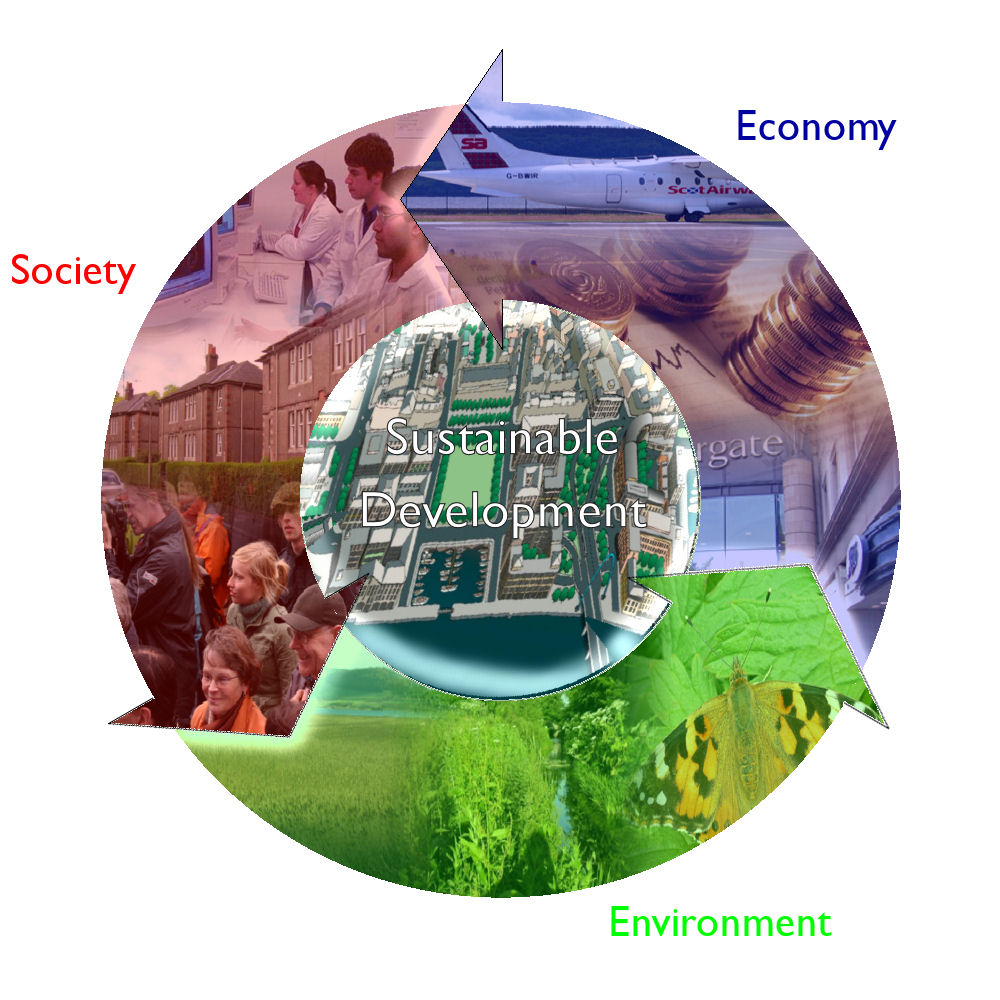


To refute the notion that environment degradation is a necessary condition for growth and development, I suggest two propositions, which assert that environment and development can, and should exist simultaneously.

Firstly, development can help conserve environment. Thus, both growth and environment conservation can be achieved together.

Constructive intervention can help enhance the quality of environment; and development facilitates constructive intervention. Thus, development can not be provided as an excuse to hamper environment. In fact, progress in the field of science and technology has given us the tools to protect the environment. Efficient electrical appliances, fuel-efficient vehicles, better methods of recycling and waste disposal, the concept of green architecture and many other such techniques are all a result of scientific advancements, which have been made possible due to investment in the field of technology. Undoubtedly, technology has made us lazy and seemingly insensitive towards nature and environment, but no one can deny that technology alone has opened up possibilities of adopting a greener lifestyle. It is, therefore, our choice: whether we wish to use technology to conserve or destroy the environment.

Secondly, environment degradation can ultimately lead to reversal of development. Thus, harming the environment to achieve “higher growth” is surely a risky prospect.

Without a clean and green environment, development has no meaning. The starkest example of this proposition would be a person who earns a 7-digit salary, but suffers from respiratory diseases due to air pollution and hence has to spend a huge portion of her/his income on medical expenses!

In addition, pollution and depletion of natural resources adversely affects livelihoods of all those who are directly dependent on the environment. Fishermen, cultivators, dairy farmers and many others are deeply affected by water pollution, soil contamination, acid rains, depletion of bio-diversity and other forms of pollution. Thus degradation of environment clearly affects employment and growth.

Moreover, noted economist and Nobel Laureate Amartya Sen asserts that environmental plunder affects distributive justice, which is an important branch of development. Pollution is caused by the affluent classes (effluents from industries, vehicular pollution, wastage of resources etc.) but its ultimate effects are borne by the disadvantaged (scarce resources, contaminated water, poor air quality etc.). Sen strongly condemns this “disguised manslaughter”. This clearly highlights the fact that severe environment damage can retard rather than promote development, through its strong distribution effects.

These linkages unambiguously underline the complementarity between environment and development. Without doubt, one can’t exist without the other.

Surely, sustainable development is not an “out of reach” phenomenon. To achieve it, we just need some simple measures, common sense, practicality and sensitivity towards the environment. We need an integration of developmental and environmental concerns. Every society, at each level can contribute towards conserving the environment. The government can make intelligent policies and ensure strict implementation of the laws. In addition, a system of incentives and disincentives could be devised, aimed at protecting the environment. For instance, efficient appliances (CFLs etc) could be subsidized, while pollution causing vehicles (fuel-guzzling SUVs) could be taxed heavily. Educational institutions can also contribute by spreading awareness and internalizing the issue in young minds, with the help of NGOs. Enterprises can fulfil their corporate social responsibility by minimizing wastage in their offices, using efficient equipment and adopting environment-friendly production processes. At the individual level, simple steps like minimizing wastage of paper, water and electricity at homes, avoiding littering in public places and above all, being aware and conscious of environment issues can go a long way in repaying our debt towards the environment.

To conclude, I would yet again assert that sustainable development is, by no means, an oxymoron. Instead, it is a phrase that needs to be incorporated in our lives at each level. It is an ideology that should be the foundation of government policies, if we genuinely wish to leave behind a clean and green Earth for our future generations.

______________________

The Author is a III yr B.A. Economics Honours student and part of the Webteam of DevelopmentChannel.org

Aparna Bisht- New Avatar of Plastics


Plastics have reigned our surroundings for more than a century now. From pens, slippers,drinking water bottles, cups, mugs, plates,toys to high end mobiles and aircraft components..They are light, inexpensive and can be moulded in more than a million ways. However they were not known to conduct electricity till date. As advancement grows by leaps and bounds these plastics are to act in an opposite manner as insulator.
Intense research has offered flexible, energy saving alternatives that could revolutionise industrial economics.A German research institute has devised a hybrid solution in a composite material that causes the cost effective plastic to conduct electricity and also is resilient like metals.And also it does not require any machinery to develop the components.


The new avatar of plastic can replace conventional plastic in automobile and aircraft manufacturing to a great extent.The headlamps housings on a car can be made more efficient and cost effective by the new conductive hybrid. Aircraft fuselage are partly made of Carbon fibre components that do not conduct electricity and a lightning stroke can have fatal consequences.A plastic metal hybrid coating would act as a safe discharge structure on such components. It will no longer be necessary to integrate metal circuit boards and the components will soon be able to be produced in a single work step,leading to reduction in product cost and the weight of the material will also be reduced drastically. Only time Will test the impact of the new hybrid plastic on our lives!

________________

The Author is a II yr college student and member of the Hansraj College Website Team of DevelopmentChannel.org

Kirthi Rao- Environmental Change


While the indifferent have lived pretty happily till now, quite ignorant of the damage their apathy has lead to, it will no longer be possible. Part of the reason why common people ( let me define 'common' as people having access to basic education and a basic standard of living) have been able to ignore the environmental implications of their actions has been that they have been insulated from it. Lining one's home with wood when it wasn't really required, not bothering to relocate and rehabilitate cut trees, wasting water, avoiding pollution checks for one's vehicle, buying that shahtoosh shawl when the conservationists were crying themselves hoarse about the endangered species- none of these actions meant that your house would be hit by a tsunami, or your neighbourhood will become extra polluted or suddenly waterless or inhabitable. But, now very soon things will have to change.

I'm saying this because the nature has started retaliating. Of course we can develop newer technology to defend ourselves. But my point is that increasingly, it'll become a fighting race. I wonder if anyone has noticed the kind of smog we've experienced this winter. I agree that one always feels that the current situation is the worst ever, but this time many weather monitoring bodies like CSE (Centre for Science & Environment) agree with me and point out that the RSPM (respirable suspended particulate matter) levels seem to be much higher than they were three years back in the windless winter days. The cause of this is the increased vehicular pollution; the burning of dry leaves and waste in the winters, the continued clearing of trees in the Capital for the Commonwealth games. For instance visit the area near Gargi College, where a wooded area has been cleared ruthlessly, so much so that the road adjacent to it is carpeted with dust now. The list goes on.


What this has caused is amply clear. Respiratory problems have been on a rise, and the Delhiite (the story holds for other cities too) who has already suffered at the hands of ever-choked killer roads, now has the added disability of not being able to see clearly in the thick smog! I speak from personal experience. Travelling Noida to Delhi in the morning and back at night, to and from work is a necessity for my family and the horrors we (and our co-commuters) faced in the first few days of January must be shared. The visibility was as low as 25 metres sometimes and due to the added truck-traffic in these hours, the commute was indeed a trial by fog. Just imagine you are in your car on a usually busy road and all you see through your windscreen is white smoky layers of smog. We saw how unnervingly easy it was for a disastrous accident to happen and indeed many fatal collisions occurred. And this is just one instance of our lives being directly affected by the way we treat our environment.

Consider the Mumbai floods of 2005. It was not only the antiquated and poorly managed drainage system which was to blame, the steady degradation, reclamation and habitation of important mangrove areas and land-sea bridge areas in the Mahim creek was a major reason. What's pitiful is that very few people even spoke about it while they were losing their breath over criticising the Brihanmumbai Municipal Corporation for the poor drainage infrastructure. This is alarming because this loss of the Mithi river and Mahim creek mangrove area had already reached a rate of 40% from 1995 to 2005; apathy will ensure that an even higher percent of the essential eco-drainage systems will be lost.

What is most important is that we speak to all we know about these issues, their causes and the need to put a stop to our ignorant plundering. And more importantly, put a stop to our plundering, careless, polluting ways!

________________

The Author is an executive member of the Website Team of DevelopmentChannel.org

Tuesday, January 27, 2009

Arushi Vats- Reloading Education


In the super-busy life we lead, seeking the ever-so-perfect dream we don’t stop, because stopping is hazardous, the person next to you might just get a step ahead. And that would not do. The system says survival of the fittest. The cream (though I question the use of this term, so many people end up consuming milk daily, the cream is set aside for other uses or for making butter that is anyways available separately. But you can’t have cream replacing milk in your daily Bournvita, can you?) go to the best colleges, the milk is left to face the prospect of thinking of a future at an open university or a private university (if it can be afforded).

But we don't really stop and think (because stopping means losing) that this system doesn’t make logic. The brightest get the best, the weakest the worst. Shouldn’t it be the other way round? For a child who is brilliant a competent teacher/guide is essential but for the child who is mediocre, the need for a competent teacher/guide increases for the brilliant child has to just fine tune, the mediocre one has to work ten times harder to achieve the highest level he can because he has to rise from mediocre to brilliant. So the weakest student should get the best teacher and the brilliant student should get a good teacher, because he can make the best out of it. It’s a challenge to make someone who is already highly discouraged by the society to realize his full potential. A challenge that can be achieved by the best, trained, seasoned teachers of this country.

Unfortunately, that doesn’t happen. What we have is, students scoring 95% getting to “choose” what they want to study at +2 level, getting the school of their choice, the best teachers and the model environment and the weakest student gets the residual school, a stream that they in all probability don’t want to study, teachers with least amount of training and expertise. What would an already discouraged student with a 60% do with an untrained teacher? Not fair!

This is so obvious, happening all over schools in India. I’m sure we all have friends that have experienced the same problems; probably some of us are a part of this ‘mediocre’ group that could have been brilliant but never became brilliant because everything that they needed was taken away as a price to be paid for mediocrity.

Can we open our minds and think how we can change this essential flaw in our system, so that students passing out from all schools and not just the brand schools have an equal stake at the good life that we are all running after? Let’s make the race fair.

_______________

The Author is I yr BA Programme Student and a Member of the Webteam of DevelopmentChannel.org

Friday, January 23, 2009

Srishti Gupta -I Have a Dream


I have a dream for the Invisible Indians. The Invisible Indians who are starving every moment, who are committing suicides due to prolonged crisis in life, who are malnourished to the extent that they hardly look like humans and those who work day and night on a small piece of land and still fail to manage a livelihood. My concern is for those 41.6% of our nation's population, who according to World Bank are still earning less than $1.25. India is slated to be the fastest growing economy of Asia in the coming years but the despondent irony is that India is still home to the largest number of hungry in the world and 47% of its children are severely malnourished. And these invisible Indians are not just confined to the 6.5 lack villages of the country; they can easily be spotted in desolate nook and corners of growing cities too. I call them invisible because there is no one to address their problems.

It's high time to actually take some stern measures and make farming a lucrative option. The manifold schemes initiated by government should be implemented more sincerely and it should be made sure people actually get the benefits they ought to get. It's imperative to hone the primary education system because most of without undermining the importance of basic education, government should make a sincere effort to produce more efficient, rational and practical farmers.our farmers are illiterate and consequently not very rational. What I strongly feel is that without undermining the importance of basic education, government should make a sincere effort to produce more efficient, rational and practical farmers And this can be done by initiating special programs for them wherein they are guided to become farmers who are certainly smarter and more in tune with the latest technology. An institute in every district which provides a degree for specialization in farming or anything similar would actually help the situation. The course structure should be such that the students are given complete insight into how to improve the agricultural production, what kind of crops to be grown, nature of fertilizers to be used as per the texture of soil they work on and many other essential things. Except in a few states, mostly farmers aren’t aware of the schemes and policies being launched for them. They still take bank loans at an interest as high as 10-12% so there is an imperative need that awareness about various loan schemes, technologies and market policies that are favorable to them should be conveyed too. There are several similar programs running but they should be presented in a manner that precisely meets the requirements of the farmers. In villages, people generally don't send their wards to schools for myriads of reasons but a course like this is sure to attract many people and benefit them too. Government can also take help from corporate sectors and NGOs to execute these plans effectively. Serious attempts should be made to produce smart "professional" farmers who too earn lavishly and this will build a solid foundation for a highly productive, internationally competitive, and diversified agricultural sector too.


My dream is that the farmers of our country, who have been suffering endlessly, should now join the league those highly successful people. Let farming become a coveted and respected profession in the country and the Agricultural Sector, one of the most profitable sectors. This I am sure will solve many other problems too only then will India truly shine!!!
_________________

The Author is a IIyr Maths Honours student and part of the Core Team of DevelopmentChannel.org

Sunday, December 7, 2008

Shivon Dhawan- Voting to Change the System


“Over 180 killed in Mumbai serial blasts”

In the wake of the recent blasts and terror strikes, it would only be human to develop, a feeling of deeper disgust, for the apparent “leaders” of the countries. The representatives, it seems, have suddenly been woken from their deep slumbers, as what has come to the attention of the nation is, the weak willed and inefficient “leaders”. The political classes’ inefficiency and aloofness, to both its responsibilities and duties has cost a lot of citizens like , you and me , maybe a friend , a cousin , a mother , a child or just someone , loved and cared for, someone cruelly taken away .

The outrage felt all over the country is not only against the terrorists but also the rot within the system. While the terror bloc maybe seen as the evil attacker, what cannot be ignored is the absolute failure of the political democratic system, not the government alone. Our country being the worlds largest democracy not only sees hurdles in the form of hostile neighbours, but now has to deal with a rotting bureaucratic and political machinery.

Perhaps the most alarming question on everybody’s mind is, “what can we do?”. With the common consensus coming to the sad fact, that no political party has been performing, no politician has any connect with the common public and that no matter how much we scream or protest , the situation is just not going to change on its own. However, the more disturbing developments are the radical ideas being suggested, such as, not paying taxes at all or the possibility of giving up the parliamentary system and coming under military rule. This is a worrisome turn of events.

Here lie the problems of the “others”. We have let our politicians alienate themselves from us. The politically sound, educated urban masses suddenly realise that the democracy they are supposed to be a part of, is not theirs at all. Be it the fact that simple needs of a human being, such as, the need for security are being ignored, leaves this class of Indians confused, angry and distort. Thus, is born the “other”, politicians. Someone who does not represent them, but governs them. .

However doesn’t a society deserve its own politicians? While we hold rallies urging each other not to pay taxes, do we realise that we are heading towards a much bigger problem? Do we realise that the system of democracy that we perceive as failing is the only weapon we have?

So what does a commoner do against the “others”? To think that we are weak or helpless is wrong. What we can do is simple .We bring the awaited change. We change them. We become a part of the process, to clean it, rather than to ignore and suffer. We need to eliminate the feeling of the other, and make the “others” a part of “us”. How? One simple word, vote. One of the most precious weapons, and a much ignored duty, is to vote. As a citizen of a democracy, it is the only way we can bring change. Changing not the machinery, but the rusted parts.


To say that we are lucky to be in a democracy is an understatement, we need to realise and appreciate the rights and freedoms given to us as Indians. Instead of doing that, we too conveniently forget our duty to vote, and then complain about the pathetic political machinery in our country. Thus, to concede defeat, to outer enemies or our own system failures is not an option, but defeating them through the democratic rights of a citizen is.

In the end, as Dorothy Thompson said,
It is not the fact of liberty but the way in which liberty is exercised that ultimately determines whether liberty itself survives

______________
The Author is I yr Journalism Honours student and Head of the Lady Sriram College Webteam of DevelopmentChannel.org

Kartik Viswanath- What can I do?


Not all, but many of us sometimes get this feeling in our gut that we need to do something with our life, that change must come within us and around us and because of us. I don’t know if you can identify with this, but if you can then you must know how painful such a feeling is. It might come because of somebody you meet, something you see happening around you, or maybe even just a very powerful movie.

And when this happens, the question we ask ourselves is simple…what can I do?

It’s the answer to that question that’s a bit tough.

I thought my first entry should talk about these very questions, the need to think about social issues, the need to create awareness and a concern about the problems faced by society. It’s only when we take the first step that the rest of the path will unveil itself to us.


Most of us live an insulated life, insulated from the pains as well as the joys in the lives of so many around us. As long as things in our life are going well, good food, good house, good bed, good friends, it takes a bit of an effort to pull out of our cocoon and take a look around to see what the guy next door has to deal with. Such behaviour is perhaps our choice, albeit on a sub-conscious level. The reason being, if we do happen to notice the hardship of another, we’ll then have to worry about him, thus ruining our perfectly good life. All this might sound cynical, but if it is, then that would mean things aren’t as bad as they seem, which is great since that’s what we all want in the end anyway, don’t we?

I’m afraid I don’t have any answers to these questions, and I don’t think any of us really do. Further, I confess that I myself am sometimes one such person, a person who does not want to know about another’s suffering, primarily because I fear it will ruin my sleep. It’s so much easier to just block it all out.

The Mumbai terror attacks had me in confused state of mind. On one hand, I felt sad and angry, helpless yet responsible, but on the other hand I felt like I really didn’t want to hear about all that anymore, that I just wanted to laugh some with my friends, eat some good food and watch some stupid Govinda flicks. The latter sounded so much easier, so much more something I’d like to do.

Working out these two opposing forces will require some thought.

________________

The Author is a II yr college student and head of the Sri Venkateshwara College Website Team of DevelopmentChannel.org

Tuesday, December 2, 2008

Srishti Gupta- The System We All Love to Hate!


When I look around me I feel the upcoming generation will be a socially conscious one. It’s been over one year of college and its an amazing feeling that almost everyone I come across seems to be involved in some socially responsible thing or the other. Citing the example of my own college, there are a few students helping the visually challenged people in the campus, some have taken up the responsibility to teach the under-privileged children or there is also a lot which goes to some village with an NGO regularly to provide any possible help to the poor villagers.

The crux is that even the most fashionable people studying in popular DU colleges not only think about social issues, in fact, they try to do their bit to improve the situation too. Its not about any single university or place. I have friends in various engineering and medical colleges who are associated with voluntary organizations and are doing considerably great things. Youth of the nation seems to be highly aware and motivated. These subtle things I feel have a profound message in them.

But the situation around sometimes defies even my positive anticipations. The country is going through a difficult phase where maladies like corruption, rampant violence etc. are proliferating and consequently prosperity is declining. Probably the reason is that, we feel strongly for things when we are young and not a part of the system that we love to despise and as we grow older, we seem to be swallowed up and become of part of the same system that troubled us in our youth. Perhaps this generation can break this cycle of inevitability.


The time lapse between wanting to change the system and becoming a part of the same is an important one. I am sure that people who constitute the present work force of our country must have had the fervor to change "things" around them in their youth. The fact that the situation is bad now proves a very vital point. We may desire to do great things in life but by the time we are experienced enough to make a difference, our priorities change. There are so many things like career, marriage, family and material goods that begin to become priorities and we prefer to somehow manage with a known evil, rather than enthusiastically attack it. There are many people who have a strong urge to do things in the just and right way but often stop themselves due to the oft-quoted practical constraints of life.

I guess there is a time in everyone's life when you feel very strongly for those little things around you and there is a desire to change things, change the system…But they say the "system changes you". Well, this need not always be the case. If you stick to your ideals, imbibe a social consciousness and are bolstered with determination and commitment, you’ll find that it IS possible to change the system, but sometimes you have to start by changing yourself.

And if my assessment of the current generation is accurate, a change is coming- and the socially conscious new generation will lead this change!

________________

The Author is a IIyr Maths Honours student and part of the Core Team of DevelopmentChannel.org